Wednesday, July 29, 2009

Contra or The Toughest Game to Beat

Contra flyerAnother arcade classic from the year 1987 that I’d like to bring to your attention (yes, the 80’s are awesome) has to do with fallen meteorites, alien invasions, and marines from an elite unit sent to blow everything up. Does that ring any bells? I bet it probably does and the reason is that this fantastic run and gun game known as “Contra” -and its sequels- were heavily influenced by the very successful action and sci-fi movies of the time, namely Predator, Rambo and Aliens.

Another great game featuring two player simultaneous gameplay, which I’d like to remind you, was something extremely rare to be found in video games at that time. And let’s face it, as good as the single player experience might be, you haven’t really played Contra until you start a multiplayer game and within a couple minutes find yourselves yelling at each other for lagging behind or taking a powerup that the other really needed. Coordination and cooperation is a must if you want to get to the last levels, but you can still have fun messing around with your partner by not letting him scroll onward and such.

contra imageYou get to be Bill or Lance, the two commando-type and fearless protagonists who are trying to prevent a plot to invade Earth by an alien army called Red falcon. Or something like that. You just shoot everything in sight, jump around avoiding enemy fire and try to collect better weapons and powerups like a flamethrower, a laser gun or a machine gun. There are eight stages in total, six side-scrolling and two behind-the-back, so get going and blow those aliens up!

Play Contra online in your browser with this Java Nes simulator (yes, it supports 2 player shenanigans!) and take a couple minutes to read this nice review of the Contra NES game.


Contra's Title (source Moby Games)
The English title of Contra comes from the way the title is phonetically displayed in Japanese, using the characters "Kon To Ra". The literal meaning behind these characters seems unimportant: "kon" means "spirit", "to" means "battle" and "ra", means some sort of cloth. Literally this would translate to something similar to "Battle Spirit Cloth". An alternate source of translation claims that the title translated is "Soul Big Dipper Gauze".

Regardless of the literal meaning, the title seems to have been written as a "gikun". What that means is that the phonetics of the title are more important than the actual meaning itself.

It has been suggested by some that the intent behind the name is even more complicated than that. "Kon To Ra" purposely chosen to sound like "Contra", a term popularly used to describe armed guerrilla forces in Central America during the 1980s.

Thursday, July 23, 2009

Double Intercepting Dragons

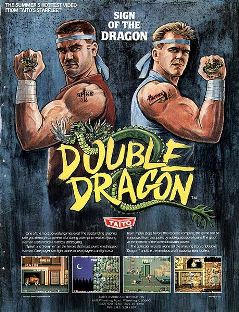
Originally conceived as a Renegade sequel, and now considered its technological and spiritual successor, “Double Dragon” included some additions never heard of before in the beat-em-up genre: a two player cooperative gameplay (hence the title) and the ability to arm your character with an enemy's weapon after disarming them.

When the game starts, you take the role of twin brothers and martial arts experts Billy and Jimmy Lee (“Hammer” and “Spike” in the original arcade versions), who are giving chase to the kidnappers of Billy’s girlfriend Marion, members of a local street gang named the “Black Warriors”. You’ll find yourself punching and kicking here and there, using various fighting techniques like the jumping backward Kick and the invulnerable Elbow Punch, and grabbing any weapon that you can get your hands on (such as whips, dynamite, bats and oil drums).

The game was strongly influenced by martial arts films, especially Bruce Lee’s classic kung-fu movie “Enter the Dragon” (the two main characters share a surname with Bruce Lee and his character in the film, and the villains Williams, Roper and Bolo are all named after characters from the movie).

What the heck are you waiting for? Play Double Dragon online right now, and if you’re having trouble getting to the end, you can have a look at the Wiki Strategy for Double Dragon tips or the Killer List of Videogames for cheats and tricks.

Dragon facts
The kanji characters in the game's title literally reads Sōsetsuryū, which roughly means "Twin Intercepting Dragons", a reference to the game's title as well as a reference to "Sōsetsuken", the fictional martial art style used by the Lee brothers. However, both the game and series are known as "Double Dragon" even in Japan.


Friday, July 17, 2009

Shooting with Wolves

I fondly remember those nights shooting everything on sight when playing the then quite popular rail-shooter “Operation Wolf” in the arcade way back when. If my mind isn’t playing tricks on me (more than usual, that is) this was the first “shooting gallery” arcade game I ever played. And let’s not forget that this was one of the first of this genre to actually have anything resembling a storyline, and one that had some similarities to real special operations missions.

Using a gun controller (with force feedback to simulate recoil! How cool was that back in the day!?) that was attached to the cabinet, your objective was to shoot as many soldiers, tanks, jeeps choppers and boats as was required per stages (there were six of them) and save the five hostages in the concentration camp.

When invading their bases, you’ll come across an awful lot of enemies that will come out of every possible hole, shooting at you like crazy, tossing grenades, knifes and even more stuff. Fortunately you can throw them grenades and knives too!


Go to take a look to the Operation Wolf entry's on the Killer List of Videogames, for a nice gathering of hints and tricks, and go check it out with this or this online version of the game right here on your browser.

Friday, July 10, 2009

Fighting in the Streets

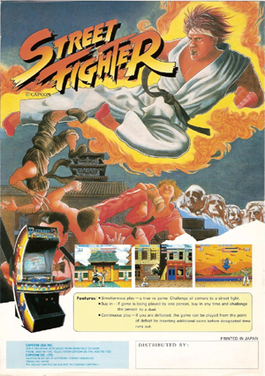
Coinciding with the release of the fourth game in the series, I will now ramble about a fighting game that first presented some of the conventions that would be (and still are) the standard in later games of the genre. That game is no other than the original arcade classic “Street Fighter” and those features were the six attack buttons, special command based techniques and bonus rounds.

Controlling a Japanese martial Street Fighter known only as Ryu, you’ll compete in an international tournament and fight in a series of matches against other characters controlled by the computer, in order to prove you’re the greatest fighter in the world.

Whenever a second human player enters the tournament, he / she will take control of Ken, who is a former trainer partner and now rival of Ryu. Whoever wins will continue to travel around the globe fighting the rest of the opponents. After defeating all nine fighters from the five different countries you travel to (Japan, USA, England, China and Thailand) you’ll face the final boss named Sagat (who would reappear in the sequel).

Probably what I remember most about the game are the special moves and techniques that can be achieved by specific button combinations. These would be largely expanded on later games, but the initial three were the “Psycho Fire”, “Surge Fist” or “Hadōken” (everyone who has played this game has said it at least once during combat!), the Dragon Punch” “Shoryūken” or “Rising Dragon Fist, and last but not least the “Hurrican Kick” or “Tornado Whirlwind Kick”.


If you’ve never kicked an opponent unconscious on Street Fighter, do yourself a favour and play street fighter online (not exactly the same, but more like SF 2), download it and save it for later or get an arcade emulator to play an exact copy and start the fighting ASAP. Click on the link to check some info and pics about the original arcade cabinet and learn all combos and moves in the strategy wiki.

Friday, July 3, 2009

Renegade With a Cause

Even though you may know this classic arcade masterpiece as “Renegade”, it’s actually a westernized conversion (including changes to all of the sprites and backgrounds) of the original Japanese arcade game "Nekketsu Kouha Kunio-kun" (which roughly translates to “Hot Blooded Punk Kunio”), probably the first side scrolling beat ‘em up game, and the one which laid the foundations for later classics like Double Dragon and Final Fight.

The story changes quite a bit depending on the version of the game, as on the American version you need to rescue your girlfriend from her kidnappers, kicking faces and other body parts through five levels that take place on the subway, the docks and some unwelcoming streets of Brooklyn. Kunio-kun on the other hand stars the titular high school student Kunio standing up for his bullied friend Hiroshi, instead of the damsel-in-distress plot of Renegade. Each level starts with the some gang members thrashing Hiroshi in front of Nekketsu High School and Kunio going after his attackers to kick the bullying outta them.

Other things changed include the Japanese school uniforms wear by the main character and his pals, the backgrounds and even some characters (one was transformed into a woman, and other changed their skin colour).

Although it’s quite a violent game –the moves you can make include head butts, punches, kicks and flying kicks- there is an undeniable attempt to tone it down with its humorous and exaggerated approach. The game introduced for the first time several trademarks of the beat 'em up genre, including 4-directional control, punch-jump-kick play action, and enemies which can sustain multiple hits. To this day, be it Renegade or Kunio-kun, it has undoubtedly been one of the most influential titles of the video game industry.


Read these good summary about Renegade and the original game with screenshots comparing all versions and check out Wikipedia's entry on Renegade to gather even more info. And you can even play Renagade for free on your browser on that SNES emulator.
https://www.google.com/analytics/settings/check_status_handler?id=16058684