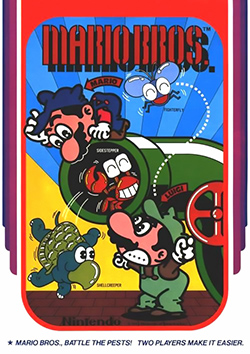
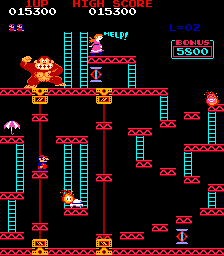
Oops, I did it again! So, before today’s game, let’s go over some cool games from 1983 besides Mario Bros: Dragon’s Lair (The first video game to use cel-animated video instead of computer generated graphics), Elevator Action (many hours spent playing it), Star Wars (oh yeah!) and I Robot (the first commercially produced 3D-polygonal game).
Without further ado, let me introduce the first side-scrolling platform game: Pac-Land. And let’s not forget that 1984 was the year where 16-bit processors were used in arcade machines for the first time, resulting in much more detailed and faster graphics.
This side-scroller for 1 or 2 players (not simultaneous) with a cartoony feel to it, featured parallax scrolling for some of the background elements, a feature that would not become usual until much later.
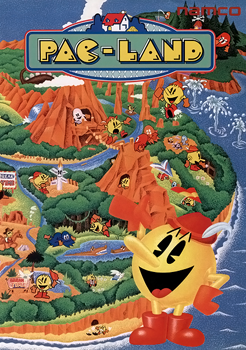
This time around, Pac-Man actually has arms, legs and even a distinguishable face and his mission is to help a lost fairy get back to her home in Fairy Land. That task will prove to be no piece of cake though, because as he travels through Pac-Land, the usual suspects (the enemy ghosts Inky, Blinky, Pinky, Clyde and Sue) will chase him on cars, aeroplanes, pogo sticks and even flying saucers trying to stop his quest. Other obstacles will appear on the way, such as water spurts and quicksand traps. On the other hand, he’ll get flying boots, fruits, and other bonuses along the way.
The game is split into trips, and in each of these trips the objective is to get the fairy (that is kept under Pac-man's hat) to Fairyland and also to return back home to Pac-Man's house. Each trip is divided into a number of rounds, the end of which provides Pac-man with bonus points depending on how much time he has left and also his position in jumping at the end of each round. During each round, our hero can grab a power pellet, which –as in the classic Pac-man game- will cause the ghosts to turn blue, making them edible for points. In some rounds, Pac must use a springboard to jump over a lake.
The majority of the trip involves moving from left to right, but for the final round of the trip, Pac-Man has to travel from right to left back home. Once he completes the trip, he’ll be greeted by Ms. Pac-Man and Baby Pac-Man. In the US release of the game, Pac-Man's cat and dog in the cartoon series, Sourpuss and Chomp-Chomp, are also there to welcome Pac-Man home. He then begins his next trip following the same objectives as before, although the difficulty is increased.
If you have to chance to play this game, I highly recommend it! I remember watching other people play this game for hours in the local arcade. And once I was old enough to try it, I was hooked for good! So go and try this free online Pac-Land version and have a good time. There also a very good entry about the game at both the Arcade History Database and the site MobyGames. Before I forget it all over again, let me tell you two more games released in 1984 that are worth mentioning here. They are Marble Madness and Paper Boy.
Munch this data
-In the American release of Pac-Land by Bally Midway, the characters' appearances are based on the designs from thePac-Man animated series produced by Hanna-Barbera, to promote the animated series, as well as the video game series. In the Japanese release by Namco, the Pac-Man sprite is closer in appearance to Namco's official artwork of the character with a longer nose, Pac-Man shaped eyes, and (for this game) a feathercap. In addition, both versions feature the main BGM and "jingles" from the aforementioned series; however, the rights to the main BGM in the game belong to Hanna-Barbara, not Namco.